

Quicklime & Hydrated Lime Testing
Sample testing enquiries for limestone, quicklime and hydrated lime with Ummed Singh at Shree Gayatri Lime Testing Lab, Khejarala, Jodhpur, Rajasthan.
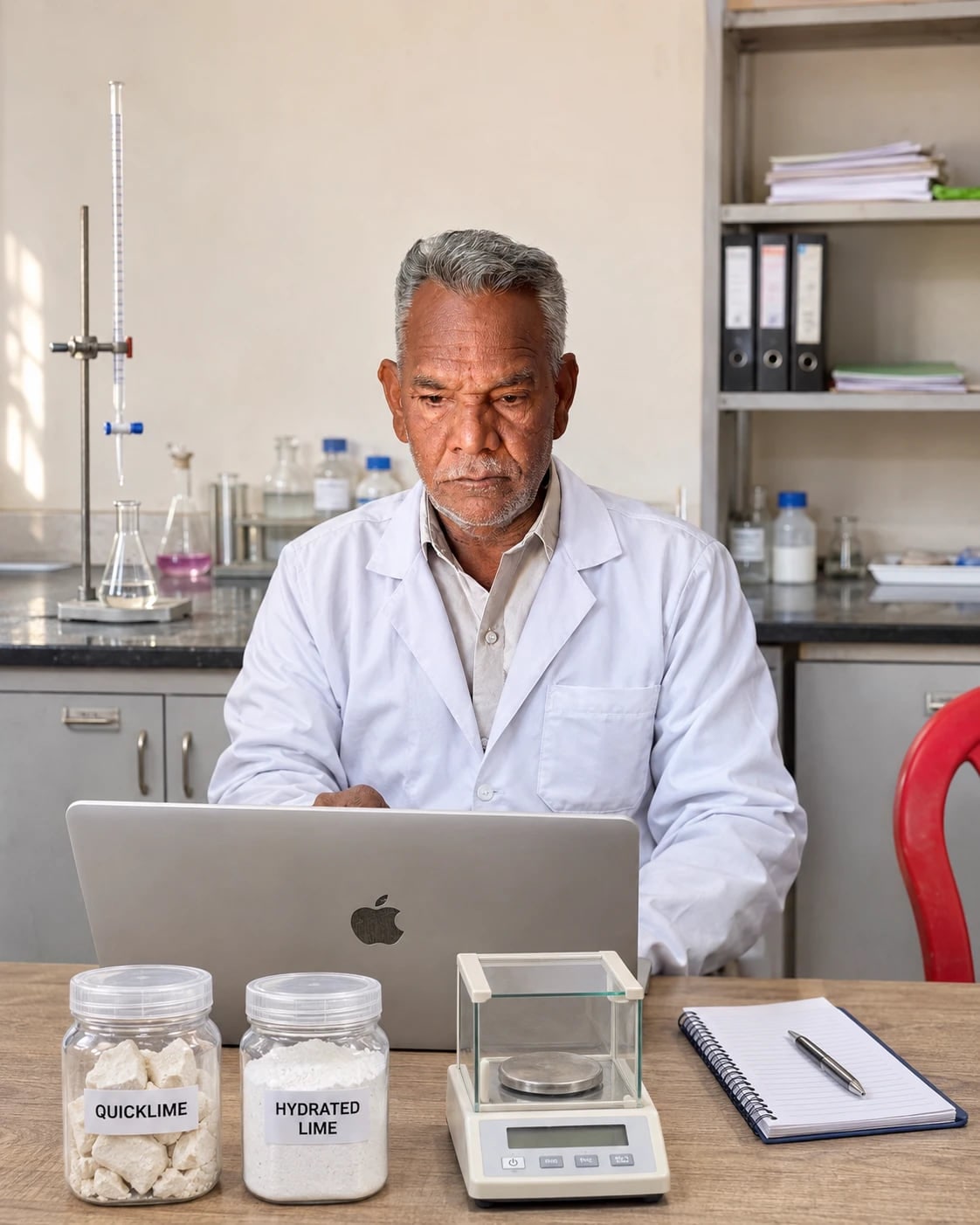
Specialist profile
Ummed Singh
Lime Testing Specialist
- 45 yearslime industry experience
- Thousandsof cross-checks and joint tests
- 4 materialslimestone, quicklime, quicklime powder, hydrated lime
Ummed Singh has 45 years of lime industry experience. For limestone, quicklime and hydrated lime sample testing, contact him at Shree Gayatri Lime Testing Lab in Khejarala, Jodhpur, Rajasthan.
He has carried out thousands of cross-checks and joint tests on quicklime and hydrated lime samples, and has a deep, practical knowledge of limestone and quicklime.
Shree Gayatri Lime Testing Lab is a separate business from Deshwali Minerals. The tests, the fees and the report are agreed directly with the lab.
Lab testing enquiries
Shree Gayatri Lime Testing Lab
- Call+91 90796 24888Call
- WhatsApp+91 99296 79702Chat
- LocationKhejarala, Jodhpur, Rajasthan
Limestone, quicklime and hydrated lime
Three materials from the same stone. Tell the lab which one you are sending — the tests that make sense depend on it.
Limestone — the raw material CaCO₃
Limestone
The quarried stone, calcium carbonate. It is burnt in a kiln to make quicklime — testing it shows how good the lime made from it can be.
Ask about limestone testingQuicklime lumps (Chuna Kali) CaO
Quicklime (Chuna Kali)
Limestone after burning: calcium oxide, as off-white lumps or ground powder. It reacts strongly with water and gives off heat.
Ask about quicklime testingHydrated lime powder Ca(OH)₂
Hydrated lime
Quicklime slaked with a controlled amount of water: calcium hydroxide, a dry fine white powder.
Ask about hydrated lime testing
Appearance alone does not establish grade or purity. Colour and texture vary from lot to lot — only a test result tells you what the sample contains.
- Limestone CaCO₃Quarried stone — calcium carbonate.CalcinationBurnt in a kiln; carbon dioxide is driven off.
- Quicklime CaOBurnt lumps or ground powder — calcium oxide.Controlled hydrationSlaked with a measured amount of water.
- Hydrated lime Ca(OH)₂Dry fine powder — calcium hydroxide.
How to read a lime test report
Four things to find on any report before you compare its figures with your specification.
Test report
Laboratory name and address
| S.No. | Specification | 3 Unit | 4 Result |
|---|---|---|---|
| 1 | Available lime as CaO | % | — |
| 2 | Magnesium as MgO | % | — |
| 3 | Acid insoluble as SiO₂ | % | — |
| 4 | Loss on ignition (LOI) | % | — |
| 5 | Reactivity (temperature rise) | °C | — |
- 1Material and sample IDCheck the report is for your material — quicklime lumps, powder or hydrated lime — and for the sample you sent, by its ID.
- 2Test methodThe method used for each line. Figures from different methods may not be comparable.
- 3Unit and reporting basisFor example % by mass, available lime as CaO or as Ca(OH)₂, and whether results are as received or on a dry basis.
- 4Measured resultThe figure for this sample. Read it against the same line of your agreed specification.
From enquiry to report
Testing is arranged directly with Shree Gayatri Lime Testing Lab. Its tests, methods, fees and report times are confirmed by the lab.
- Identify your materialLimestone, quicklime lumps, quicklime powder or hydrated lime — and where the sample comes from.
- Confirm the required testsAgree with the lab which tests suit your use, and how the report will reach you.
- Submit your sampleShare photos on WhatsApp first; confirm the delivery address and courier with the lab before dispatch.
- Review your reportCheck the method, unit and basis, then compare each result with your specification.
Include in your WhatsApp message
- The material — limestone, quicklime lumps, quicklime powder or hydrated lime
- Where the sample comes from
- The tests you need, or what the lime is used for
- Your buyer specification, if you have one
Parameters to discuss with the lab
What each common line on a lime report helps you assess. It is not a list of the tests the lab offers — ask the lab which of these it carries out for your sample.
- Available limeQuicklime, hydrated lime
- How much of the lime is free to react — usually the figure that matters most for dosing and process performance.
- Total CaOLimestone, quicklime, hydrated lime
- All the calcium in the sample, expressed as calcium oxide, whether or not it is free to react. Read it alongside available lime.
- MgOLimestone, quicklime, hydrated lime
- Magnesium content. It changes how the lime behaves in some processes, for example slag in steelmaking or scale in sugar evaporators.
- Silica (SiO₂)Limestone, quicklime, hydrated lime
- A common impurity. Higher silica means less useful lime per tonne and more insoluble residue or grit.
- Loss on ignition (LOI)Quicklime, hydrated lime
- Weight lost on strong heating. In quicklime it points to unburnt stone or lime that has taken up moisture and air; in hydrated lime it also includes the combined water.
- MoistureHydrated lime
- Free water in the powder, which affects handling, storage and the weight you pay for.
- Particle sizeQuicklime powder, hydrated lime; lump size for quicklime
- How fine the powder is, or the size range of lumps — it affects feeding, mixing and how fast the lime reacts.
- ReactivityQuicklime
- How quickly quicklime slakes and heats up in water — useful for slaking plants and processes that need fast-acting lime.
Which of these Shree Gayatri Lime Testing Lab tests, by which method, and how the results are reported are confirmed by the lab.
Testing or buying lime?
Sample testing is handled by the lab. Lime supply, rates and quotations are handled by Deshwali Minerals.
Lab testing enquiries
Shree Gayatri Lime Testing Lab
Khejarala, Jodhpur, Rajasthan
- Call: +91 90796 24888
- WhatsApp: +91 99296 79702
Product enquiries
Deshwali Minerals
Quicklime, quicklime powder and hydrated lime made at Borunda, Rajasthan.
- Phone and WhatsApp: +91 88750 20202
- Email: contact@deshwaliminerals.com
Quicklime lumpsHydrated limeHow Deshwali Minerals checks its own material